When you hear the word “cannabinoid,” you probably think of cannabis, hemp, CBD, or THC.
But here’s something that may surprise you: your body makes cannabinoids of its own.
Long before you ever encountered CBD—or even knew what a cannabinoid was—your body was already producing its own cannabinoid-like molecules.
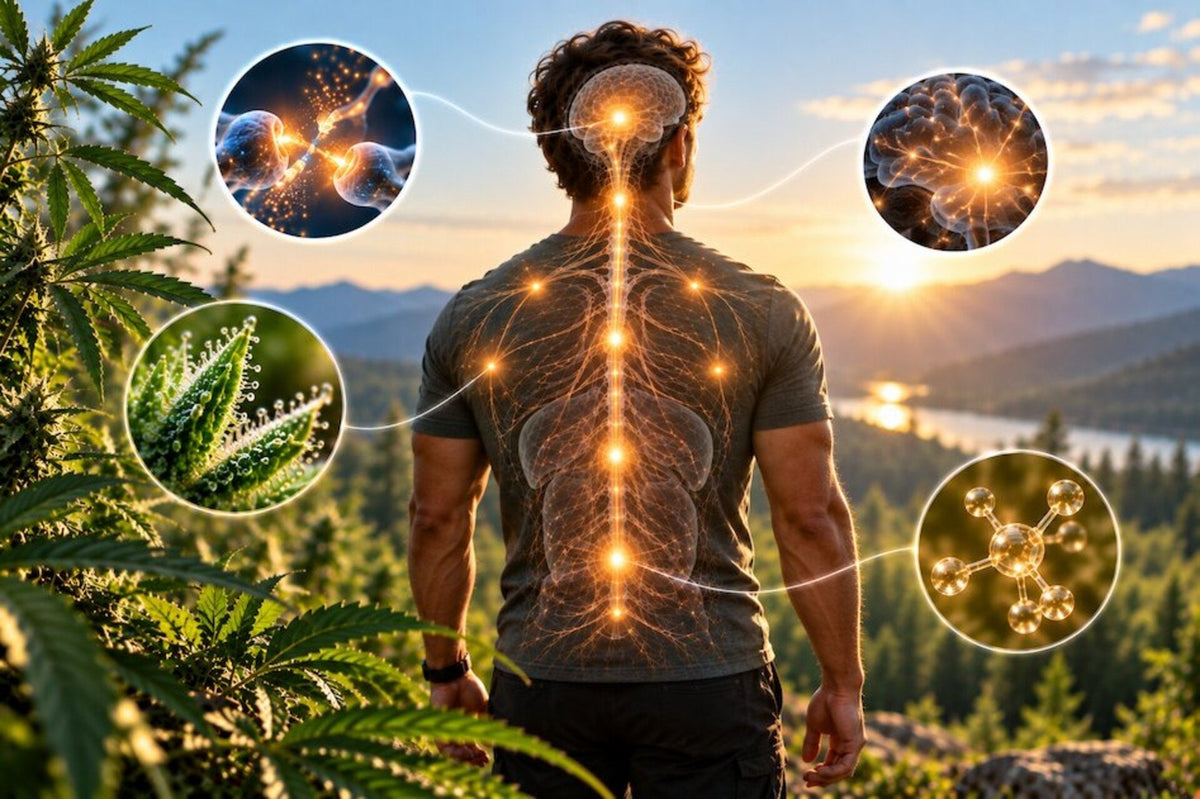
These molecules are part of an intricate communication network called the endocannabinoid system, or ECS.
Scientists are still uncovering everything the endocannabinoid system does, but we know it helps regulate a remarkably wide range of processes.
These include mood, appetite, sleep, memory, stress responses, immune activity, and how we perceive discomfort.
Understanding this system also helps explain something that might seem strange:
👉 Why would compounds from the hemp plant have any effect on the human body in the first place?
The answer begins not with the plant, but with us!
What Is the Endocannabinoid System?
The endocannabinoid system (ECS) is a signaling network found throughout the body. Its name sounds complicated, but it becomes easier to understand when you break the word apart.
“Endo” means within. An endocannabinoid, therefore, is a cannabinoid-like substance produced within your own body.
The ECS has three main components:
-
Endocannabinoids—chemical messengers your body produces
-
Cannabinoid receptors—structures that receive those messages
-
Enzymes—proteins that help make and break down endocannabinoids
An enzyme is simply a type of protein that helps chemical processes happen inside the body. You can think of enzymes as tiny biological workers, each with their own special jobs to do.
Together, these different parts of the ECS help cells communicate and respond to changing conditions.
How the Endocannabinoid System Helps the Body Maintain Balance
One of the most useful concepts for understanding the endocannabinoid system is homeostasis.
Homeostasis means maintaining relatively stable internal conditions even as things around you—or inside you—change. Your body does this constantly.
If you get too hot, you sweat. If your blood sugar drops, your body responds. If you haven't eaten in hours, hunger signals become stronger.
When you're confronted with a threat, your body prepares to protect you. When the threat passes, other systems help you return toward a resting state.
You don't consciously manage most of these adjustments. Your body has interconnected systems that do the work for you, somewhat on autopilot.
The endocannabinoid system is one of the signaling systems involved in this ongoing regulation.
It may help to think of the ECS less like an on/off switch and more like a feedback system. It helps cells respond to what is happening and adjust their activity in real time.
That doesn't mean the ECS controls everything or that simply “boosting” it would automatically improve health. Human biology is far more complicated than that.
The ECS interacts with many other systems in the body, and scientists are still studying exactly how those relationships work.
Meet Anandamide: The So-Called “Bliss Molecule”
One of the best-known endocannabinoids is anandamide, also called AEA.
Its name comes from ananda, a Sanskrit word associated with bliss or happiness. That origin helped give anandamide its popular nickname, the “bliss molecule.”
That nickname is catchy, but anandamide does much more than make us feel happy.
Researchers have studied its involvement in mood, stress response, appetite, memory, reward, and the body's processing of discomfort.
Anandamide acts as a messenger. When it is produced, it can interact with cannabinoid receptors and other targets, helping influence how cells respond.
The important point is that anandamide isn't a substance we discovered in a plant and then added to human biology. It's something the human body naturally produces.
And it isn't alone.
Meet 2-AG: Another Important Endocannabinoid
Another major endocannabinoid is called 2-arachidonoylglycerol, mercifully shortened to 2-AG.
2-AG is found in relatively high amounts in many tissues and is an important signaling molecule within the ECS.
Although anandamide and 2-AG belong to the same general system, they aren't identical and don't necessarily perform the same jobs.
They can differ in where they're produced, how strongly they interact with receptors, and how they're broken down.
That's an important lesson about cannabinoids in general: belonging to the same chemical family doesn't mean two compounds behave in the same way.
The same principle applies when we eventually move from the cannabinoids our bodies make to cannabinoids produced by plants.

How Does the Endocannabinoid System Work?
Here's another fascinating feature of the ECS: endocannabinoids generally aren't handled like a stockpile of chemical messengers waiting on a shelf.
Instead, they can be made on demand in response to cellular activity.
Imagine two nerve cells communicating. Nerve cells send chemical messages to one another using substances called neurotransmitters.
Neurotransmitters are simply chemicals the nervous system uses to pass signals rapidly from one cell to another. Endocannabinoids can become part of this conversation.
In some situations, they travel backward across the communication gap between nerve cells and essentially provide feedback to the cell that sent the original signal.
You don't need to remember the technical details. The big idea is more useful:
Your body can produce endocannabinoids in response to what's happening, use them to send a message, and then break them down when that message is no longer needed.
In simplified form, the process looks something like this:
Something changes → an endocannabinoid is produced → it interacts with a receptor → the signal influences cellular activity → the endocannabinoid is broken down.
It's a dynamic system, continually responding to the body's circumstances.
What Are CB1 and CB2 Receptors?
Chemical messengers need somewhere to deliver their messages. That's where receptors come in.
A receptor is a protein on or within a cell that can respond when the right chemical interacts with it. A common analogy is a lock and key, although real biology is more complicated than that.
The two best-known cannabinoid receptors are CB1 and CB2.
CB1 receptors are especially abundant in the central nervous system, meaning the brain and spinal cord.
That helps explain why cannabinoid signaling can be involved in processes such as memory, appetite, mood, movement, and the perception of discomfort.
CB2 receptors are strongly associated with immune cells and tissues outside the brain, although both CB1 and CB2 are found more widely throughout the body than these simple descriptions suggest.
These aren't the only biological targets connected with cannabinoid signaling. The ECS interacts with a broader network of receptors and pathways.
So, while “CB1 is in the brain and CB2 is in the immune system” is an easy shorthand, the actual biology is considerably richer.
What Happens to Endocannabinoids When Their Job is Done?
A well-regulated communication system needs a way to stop messages as well as send them.
That's where another group of enzymes comes in.
One called FAAH—short for fatty acid amide hydrolase—plays a major role in breaking down anandamide.
Another called MAGL, or monoacylglycerol lipase, is a major enzyme involved in breaking down 2-AG.
There's no need to memorize those names. What's important is what they tell us about the ECS.
Balance doesn't mean simply producing more endocannabinoids. The body also needs mechanisms for clearing those signals when their work is done.
Think of it like a conversation. Good communication depends not only on knowing when to speak but also on knowing when to stop talking.

How Do CBD, THC, and Plant Cannabinoids Interact with the ECS?
This is where the story circles back to hemp.
Cannabinoids produced by plants are called phytocannabinoids. “Phyto” simply means plant.
CBD, THC, CBG, CBN, and other cannabinoids found in hemp and cannabis fall into this category.
The important distinction is:
💪 Endocannabinoids are produced by your body.
🌱 Phytocannabinoids are produced by plants.
The two groups aren't identical, but some phytocannabinoids can interact with the receptors, enzymes, and other biological pathways involved in our own cannabinoid signaling.
THC, for example, can directly activate CB1 receptors. That's one reason THC can produce its characteristic intoxicating effects.
CBD works quite differently. Its biology is more complex and involves a variety of molecular targets rather than simply acting like THC at CB1 receptors.
This interaction between plant cannabinoids and our own biological signaling systems makes hemp-derived cannabinoids such an interesting area of research.
It also helps explain why they’ve become increasingly popular in everyday wellness routines.
For people who choose to incorporate hemp into their routine, the important questions become what cannabinoids a product contains, how much it provides, and how thoughtfully the formula has been designed
In other words, cannabis didn't give humans an endocannabinoid system.
Our bodies already had one. Plant cannabinoids happen to interact with parts of biological machinery that were already there.
That's one reason understanding the ECS is so helpful when trying to understand cannabinoids more broadly.
Want to learn more about the cannabinoids found in hemp? Read our guide to “what cannabinoids are and what they're good for.”
What Does Everyday Life Have to Do with the ECS?
You don't need to consume hemp-derived cannabinoids for your ECS to be active. It's working as part of your normal physiology every day.
Researchers have found relationships between endocannabinoid signaling and a variety of everyday experiences and behaviors, including physical activity, sleep, stress, eating, and metabolism.
Exercise offers a particularly interesting example.
The “Runner's High” and the ECS
For decades, the pleasant feeling some people experience after sustained exercise was commonly attributed to endorphins—chemicals produced by the body that are involved in pain modulation and other responses.
Endorphins probably aren't the whole story.
Research has found that acute exercise can increase levels of endocannabinoids, particularly anandamide.
Scientists are now studying whether endocannabinoid signaling helps explain features associated with the “runner's high,” including improved mood, reduced anxiety, and decreased perception of discomfort.
That doesn't mean we've completely solved the mystery of why exercise can feel so good.
Human studies have found strong associations between endocannabinoids and the runner’s high.
However, researchers are still determining how much of this effect can be attributed to endocannabinoids versus other chemical changes occurring during exercise.
The bigger takeaway is fascinating, though:
👉 Some of the same biological signaling pathways that make plant cannabinoids interesting are also active when you go for a run, ride a bike, or engage in other physical activity.

Sleep, Stress, Food, and the ECS
The endocannabinoid system is also connected with the body's regulation of sleep and wakefulness, stress responses, appetite, and energy use.
For example, endocannabinoid activity changes over the course of the day, and sleep disruption has been associated with changes in this signaling system.
Stress also affects endocannabinoid signaling.
That's not surprising when you consider that responding to challenges—and then returning toward a more stable state afterward—is one of the recurring themes in ECS research.
Diet adds another layer. Anandamide and 2-AG are lipid-based molecules, meaning they are made from fat-related building blocks.
Researchers continue to investigate how diet, metabolism, and different types of dietary fats may influence endocannabinoid signaling.
None of this means there's a simple “endocannabinoid diet” or lifestyle trick that guarantees an optimized ECS.
Instead, it points to something more interesting: the ECS is woven into ordinary human physiology. It doesn't operate separately from sleep, movement, nutrition, stress, and the rest of the body.
There's Still a Lot We Don't Know About Endocannabinoids
It's tempting to hear that the endocannabinoid system is involved in so many areas and conclude that manipulating it must therefore improve all of them.
Science doesn't work quite that neatly.
When researchers discover that a receptor or signaling molecule is involved in a biological process, that doesn't automatically mean increasing or decreasing that signal will produce a health benefit.
A laboratory finding is also different from a proven clinical effect in people.
Scientists are still investigating how endocannabinoid signaling varies between individuals and how it changes with age and health status.
They’re also exploring how different cannabinoid pathways interact and when modifying those pathways may—or may not—be useful.
This distinction is especially important when evaluating wellness claims about cannabinoids.
Interesting biology can support further research, but it shouldn't be mistaken for proof that a particular product can prevent, treat, or cure a medical condition.
Supporting Balance Isn't the Same as “Fixing” Your ECS
You may occasionally encounter claims that common symptoms are signs of an “endocannabinoid deficiency” or that taking cannabinoids will automatically restore a deficient system.
That's a much stronger claim than current science seems to support for general wellness.
The ECS isn't a gas tank that simply needs to be topped off with cannabinoids.
It's a complex signaling network that interacts with the nervous system, immune system, metabolism, hormones, and other parts of human physiology.
So, rather than viewing hemp products to “fix” the endocannabinoid system, they'd be better approached as one part of a broader wellness routine.
At Ultra Botanica, that philosophy informs how we formulate our hemp products.
Cannabinoids are one piece of the picture, alongside the everyday foundations of wellness such as movement, sleep, nutrition, and stress management.
The ECS should always be considered within the larger context of health too. Regular healthy habits influence numerous systems in the body—and the ECS is part of that interconnected picture.
Plant cannabinoids can also interact with aspects of this system, which is why they remain such an active area of scientific research.
But they aren't replacements for the body's own endocannabinoids, nor should the ECS be viewed as a single switch that needs to be turned up.

Interested in Exploring Hemp Cannabinoids?
Understanding the endocannabinoid system can make choosing a hemp product a little less intimidating.
Instead of looking only for the biggest number on the label, consider the cannabinoids included, the amount per serving, the type of hemp extract used, and whether the product has been tested for quality and purity.
Curious about incorporating hemp-derived cannabinoids into your wellness routine? Explore Ultra Botanica's hemp formulas and learn how each one is formulated.
✅ Explore Ultra Botanica Hemp Products →
New to cannabinoids? Our guide to “What Are Cannabinoids and What Are They Good For?” is a good place to start.
The Bottom Line: Cannabinoids Start With You
Perhaps the most surprising thing about cannabinoids is that their story doesn't begin with cannabis.
It begins inside the human body.
We produce our own cannabinoid-like messengers, including anandamide and 2-AG. We have receptors that respond to those messengers. Our bodies have enzymes that create and break them down.
Together, these components form a signaling system that supports the body's response to an ever-changing internal and external environment.
That doesn't make the endocannabinoid system a magic explanation for health.
It makes it something more scientifically interesting: one part of an extraordinarily complex network of systems working together every moment of every day.
And it gives us a much better starting point for understanding CBD, THC, and other plant cannabinoids.
After all, the question isn't simply, “What do cannabinoids do to us?”
The deeper question is: Why is the human body able to respond to cannabinoids at all?
Now we know where to begin looking for the answer.

FAQs
1. What is the endocannabinoid system?
The endocannabinoid system, or ECS, is a signaling network found throughout the body.
It includes endocannabinoids made by the body, receptors that respond to those chemical messengers, and enzymes that make them and then break them down.
The ECS is involved in regulating many normal processes, including mood, appetite, sleep, stress response, immune signaling, memory, and the perception of discomfort.
2. Does the human body make cannabinoids
Yes. The body naturally produces substances called endocannabinoids.
Two of the best-studied are anandamide and 2-arachidonoylglycerol (2-AG). They act as chemical messengers within the endocannabinoid system.
3. What are CB1 and CB2 receptors?
CB1 and CB2 are the two best-known cannabinoid receptors.
CB1 receptors are particularly abundant in the brain and central nervous system, while CB2 receptors are strongly associated with immune cells and tissues throughout the body. Both are part of the body's broader cannabinoid signaling network.
4. What is anandamide?
Anandamide is an endocannabinoid naturally produced by the body.
Sometimes nicknamed the “bliss molecule,” it has been studied for its involvement in processes including mood, reward, appetite, memory, stress response, and discomfort signaling.
5. What does exercise have to do with endocannabinoids?
Exercise can affect endocannabinoid signaling, and studies have found increases in circulating endocannabinoids such as anandamide following acute exercise.
Researchers are investigating whether this signaling helps explain some of the positive feelings associated with the “runner's high” as well or better than endorphins do.
6. Is CBD an endocannabinoid?
No. CBD, or cannabidiol, is a phytocannabinoid, meaning it comes from a plant. Endocannabinoids are produced within the human body.
CBD can interact with several biological pathways associated with cannabinoid signaling, but it does not work in the same way as the endocannabinoids your body produces.
7. Do I need to “boost” my endocannabinoid system?
There isn't good evidence that everyone needs to “boost” or supplement their ECS. The endocannabinoid system is a complex regulatory network, not a tank that simply needs to be filled up.
Sleep, exercise, nutrition, stress, metabolism, and many other aspects of normal physiology interact with endocannabinoid signaling. A better way to think of supplementing is that it can help support everyday wellness.


Share:
Your Brain Is Silently Pleading for You to Do This
Broccoli Seed Extract 101: What It Is, How It Works, and Why Sulforaphane Matters